
Real confidence comes from practicing what you would actually do, not just hoping you will be fine.
Adult Self-Defense Classes work best when they change two things at the same time: how you see the world around you, and what you can do with your body under pressure. That combination is why so many adults start training for “just in case” moments and end up noticing a bigger shift, like walking with their shoulders down instead of up by their ears.
In Bohemia, life moves fast. Many of us commute, run errands after dark, juggle family schedules, and park in lots that are not always well-lit. Our goal is simple: help you build practical skills that hold up in real life, and build the confidence that comes from repeated, realistic practice.
When you train Adult Self-Defense, the wins add up in a very everyday way. You scan a parking lot without looking paranoid. You speak up sooner. You recognize a situation before it becomes a problem. And if it does become a problem, you are not starting from zero.
Why Adult Self-Defense Classes Build Confidence So Quickly
Confidence is not a motivational quote. It is a feedback loop: you learn a tool, you pressure test it safely, you prove to yourself you can act, and your brain starts filing “I can handle this” as a real option.
Research on martial-arts-based self-defense programs consistently reports improvements in self-efficacy, reduced anxiety, better stress management, and greater situational awareness after training, even in short courses. Controlled studies also show statistically significant confidence gains after brief self-defense training, especially for women facing realistic violence scenarios. That matters because confidence is not just a feeling, it changes behavior: posture, boundaries, and decision-making.
In our Adult Self-Defense Classes, we see the fastest confidence jump when you stop guessing and start rehearsing. You learn what distance looks like. You learn what your voice sounds like when you use it on purpose. You learn how your balance changes when you are startled, and how to get it back.
Confidence is physical and mental, not just “mindset”
A lot of adults assume confidence is something you either have or do not have. We treat it more like a skill you can practice.
We build confidence through:
- Clear, repeatable techniques that do not rely on size or athleticism
- Scenario-based training that includes verbal boundaries and movement
- Progressive intensity, so you learn without getting thrown into the deep end
- Stress inoculation drills that teach you to keep thinking while your heart rate climbs
This is also why Adult Self-Defense Classes feel different from general fitness. Fitness is great, but fitness alone does not teach you decision-making under pressure.
Real-World Safety Starts Before Any Physical Technique
The most effective “self-defense move” is avoiding the fight entirely. That is not a slogan, it is a strategy. We spend real time on awareness, positioning, and early exits because those skills reduce risk long before your hands ever come up.
Situational awareness you can actually use
We keep awareness practical, not dramatic. You do not need to walk around on high alert. You need a simple system that works when you are tired, distracted, or carrying groceries.
We coach you to notice:
- Distance and angles (who is close enough to touch you in one step)
- Obstacles and exits (where you would move if you had to leave fast)
- Pre-attack cues (behavior that does not match the setting)
- Boundary testing (small pushes that test whether you will comply)
This is where Adult Self-Defense training often changes how you feel in everyday places like gas stations, parking lots, and sidewalks outside stores. You stop drifting. You start choosing position.
Verbal skills that prevent escalation
Real situations often start as uncomfortable conversations, not movie-style attacks. We train simple, direct language you can access under stress. It is not about “being tough.” It is about being clear.
You practice using your voice to:
- Set boundaries early
- Create distance without apologizing for it
- Get attention from others when you need it
- Buy time to move, escape, or access your phone
When you combine voice, movement, and awareness, you improve the odds of avoiding the physical fight altogether.
What You Learn in Our Adult Self-Defense Classes (And Why It Works)
A common fear is, “Will this actually work in a real attack?” No training can guarantee outcomes, but studies and program evaluations show trained participants report higher confidence and better outcomes in simulated threats. Many summaries of program outcomes also suggest trained people are substantially more likely to escape or avoid harm, including aggregated claims of higher escape rates for those with training. In plain terms: practicing realistic skills improves your chances.
Our Adult Self-Defense Classes focus on high-percentage situations and high-percentage responses. We would rather you know a few things well than a hundred things you cannot recall under stress.
Here is what that looks like in a typical curriculum:
- Stance, movement, and balance so you can stay upright and mobile when startled
- Defenses and counterattacks that prioritize simple mechanics under adrenaline
- Escapes from common grabs and holds, including wrist grabs and bear hugs
- Getting up safely and creating space if you end up on the ground
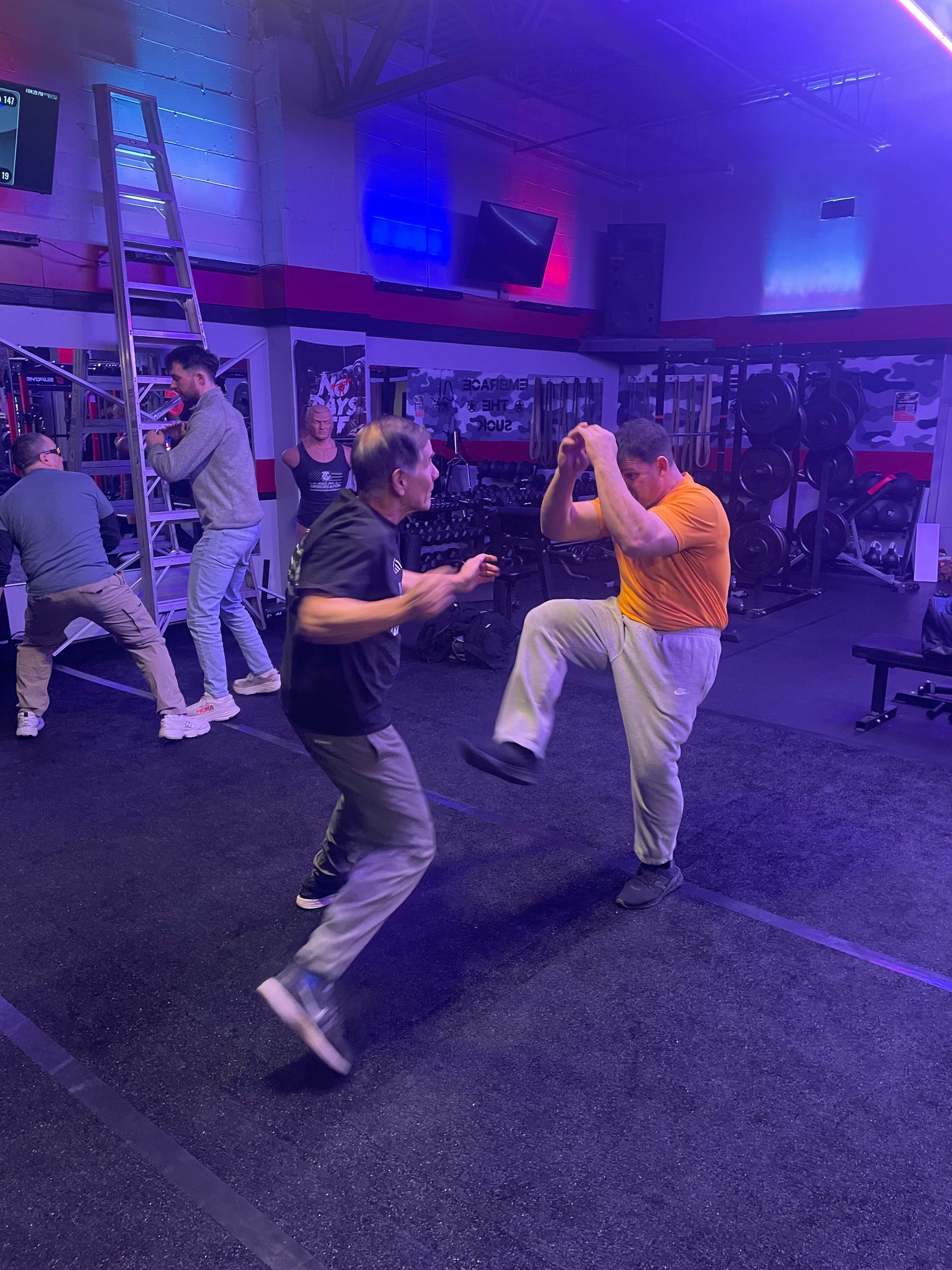
- Training against “non-cooperative” pressure in controlled drills, so techniques are not just theoretical
We also build the habit of scanning after action, creating distance, and exiting. Self-defense is not “win the fight,” it is “end the danger.”
How Training Changes Your Body Language and Personal Boundaries
One of the most underrated benefits of Adult Self-Defense Classes is how quickly your body language shifts. It is subtle, but it shows up everywhere: at work, while commuting, in social settings, even in how you stand in line.
When you practice movement and striking mechanics, your posture naturally improves. When you practice verbal boundaries, your tone gets more direct. When you pressure-test decisions in scenarios, you stop freezing as often, because you have rehearsed options.
That matters because predatory behavior often looks for easy compliance. Training does not make you invincible, but it can make you harder to manipulate, and quicker to act.
Stress response: learning to work with adrenaline
Under threat, your body does what bodies do: heart rate spikes, fine motor skills drop, tunnel vision kicks in. We plan for that.
We train techniques built for gross motor movement, and we add stress gradually so you learn what it feels like to perform with adrenaline in the mix. Over time, your nervous system gets less surprised by stress. That is a real form of psychological resilience, and research in this space repeatedly links self-defense training with improved coping and reduced anxiety.
Self Defense Bohemia NY: Training for the Places You Actually Go
Self defense Bohemia NY needs to feel relevant to daily life here. That means we do not keep everything “gym perfect.” We talk through the settings you recognize: walking to your car after errands, stepping out of a restaurant at night, moving through a parking lot with headphones in, or getting approached when you are loading the trunk.
We build scenario training that fits common Long Island routines:
- Parking lot awareness and movement, including how to use distance and angles
- Car-entry and car-exit habits that reduce vulnerability
- Commuter-style scenarios where space is tight and reactions need to be simple
- Boundary setting in public places where you want to stay calm but firm
These details matter because context changes decision-making. The more your training matches real settings, the easier it is to retrieve under stress.
Do You Need to Be Athletic or Experienced?
No. Adult Self-Defense is for adults with real schedules, real stress, and real bodies. We train people who have never thrown a punch and people who have been active for years. The common denominator is willingness to practice.
Research and program guidance around adult self-defense consistently finds that courses designed for varied fitness levels can still produce measurable gains, because good training emphasizes technique, leverage, and decision-making rather than brute strength.
We also scale intensity. You will not be thrown into full-contact chaos on day one. You will build foundations first, then add realism as your comfort and control improve.
How Long Until You Feel More Confident?
Many adults feel a noticeable confidence shift within the first few sessions, simply because you move from uncertainty to having a plan. Studies on short self-defense courses show significant confidence gains after brief training blocks, and that matches what we see: the first milestone is knowing what to do with your hands, your feet, and your voice.
Skill retention is a real issue, though, and we treat it honestly. If you train for a weekend and never revisit the material, your timing and recall can fade. That is why we encourage consistent practice, plus periodic refreshers and scenario nights that help you keep skills accessible.
A simple way to think about it:
1. Early phase: you learn tools and start feeling steadier
2. Middle phase: you pressure-test and refine so skills hold up under stress
3. Long-term: you maintain and sharpen, so confidence stays real, not imagined
This is where Adult Self-Defense Classes become less about “learning moves” and more about building a capability.
What to Expect in Your First Class
Most adults are a little nervous before the first session. That is normal. We keep the environment structured and supportive, and we focus on safety from the start.
In your first class, you can expect:
- A quick orientation so you know how training flows
- Warm-ups that prepare joints and balance without trying to smoke you
- Technique instruction with clear progressions and coaching
- Controlled partner work where you can practice without fear of getting hurt
- Time for questions so you leave with clarity, not confusion
We also emphasize good training culture: respect, control, and safety protocols that let you train hard without being reckless. That is how you build real skills over time.
Membership Options and Flexible Training for Adult Schedules
Adults do not live on a perfect routine. Work travel happens. Kids get sick. Life gets busy. We build our training options with that reality in mind.
Our Adult Self-Defense offerings are typically structured around:
- Beginner series that build a solid base over several weeks
- Short workshops that deliver a strong confidence boost and clear takeaways
- Scenario-based sessions that help you apply skills in realistic contexts
- Ongoing classes that support long-term improvement and retention
We also recommend checking the class schedule page regularly, since evening and weekend availability can be the difference between “I want to do this” and “I can actually do this.”
Women-Only and Trauma-Informed Options (And Why They Matter)
A lot of adults want training that feels psychologically safe as well as physically safe. Recent best-practice research around women-focused and feminist self-defense programs highlights long-term empowerment effects and recommends trauma-aware pedagogy to support participation, learning, and retention.
We take that seriously. Trauma-informed coaching is not about making training soft. It is about giving you agency: clear explanations, consent-based partner work, options to scale intensity, and an environment where you can learn without being pushed past what is productive.
If you are looking for Adult Self-Defense Classes with a women-only format or a trauma-aware approach, we can guide you toward a starting point that feels right and sustainable.
Take the Next Step
Building real confidence takes more than reading tips, and it takes more than fitness alone. When you train consistently, you get a practical toolkit: awareness, boundaries, de-escalation, and physical skills you can access under stress. That is what our Adult Self-Defense Classes are designed to deliver, especially for the real routines and environments that come with life in Bohemia.
We have built our programs around realistic scenarios, progressive coaching, and a training culture that keeps you safe while you learn to handle pressure. When you are ready to train with purpose, Storm Krav Maga is here to help you turn that goal into something you can feel in your posture, your decisions, and your day-to-day peace of mind.
Take control of your personal safety and fitness with practical STORM Krav Maga training by starting your free trial now.